Some links on this page are affiliate links — if you buy through them we may earn a small commission at no extra cost to you. How we make money.
Buy the red bag. Extra Gold is a genuinely different blend, but the difference in the glass is small, and red is the taste Thai restaurants actually serve. Buy Extra Gold if you brew strong, drink it often enough to notice a slightly maltier cup, or you're making Thai tea for other people who'll drink it black.
The one thing worth knowing before either: both are dyed, and they don't use the same dye. Details below, because that's the difference most pages don't mention at all.
First — make sure you're comparing bags, not formats
"Gold" means two different products on a shelf, and this trips people up constantly:
- Extra Gold — a 400 g loose mix in a bag, the premium sibling of the red Number One Brand mix. This is the one this page is about.
- Gold Label tea bags — small individual bags, usually sold in a tin. Convenient, much more expensive per glass, and a different decision entirely — see powder vs leaves.
If the bag you're holding is 400 g of loose mix, you're in the right comparison.
Names on the bag, if you are matching a listing: the brand is ชาตรามือ in Thai. The red bag is the red label (赤ラベル) and Extra Gold the gold pack (金色パック) in Japanese listings; "Number One Brand" and "Cha Tra Mue" are the same product. What the brand is, all its lines: Cha Tra Mue.
What's actually different
The colouring — the real difference, and nobody mentions it
Both bags contain added colour. They are not the same colour. Published ingredient panels list:
- Red / Number One Brand: red tea powder (Assam) 94%, sugar 5%, artificial flavour, FD&C Yellow No. 6 (E110, Sunset Yellow).
- Extra Gold: tea 94%, sugar 5%, artificial colour E133 and E102 (Brilliant Blue and Tartrazine).
Both carry the EU's attention warning on the label — E110 on the red, E102 on the gold — and neither requires one in the US. That's a labelling rule, not a finding of harm, and we explain it properly in Thai tea without dye. If you came here hoping gold is the natural one: it isn't. Neither is. That's a different aisle.
The tea itself
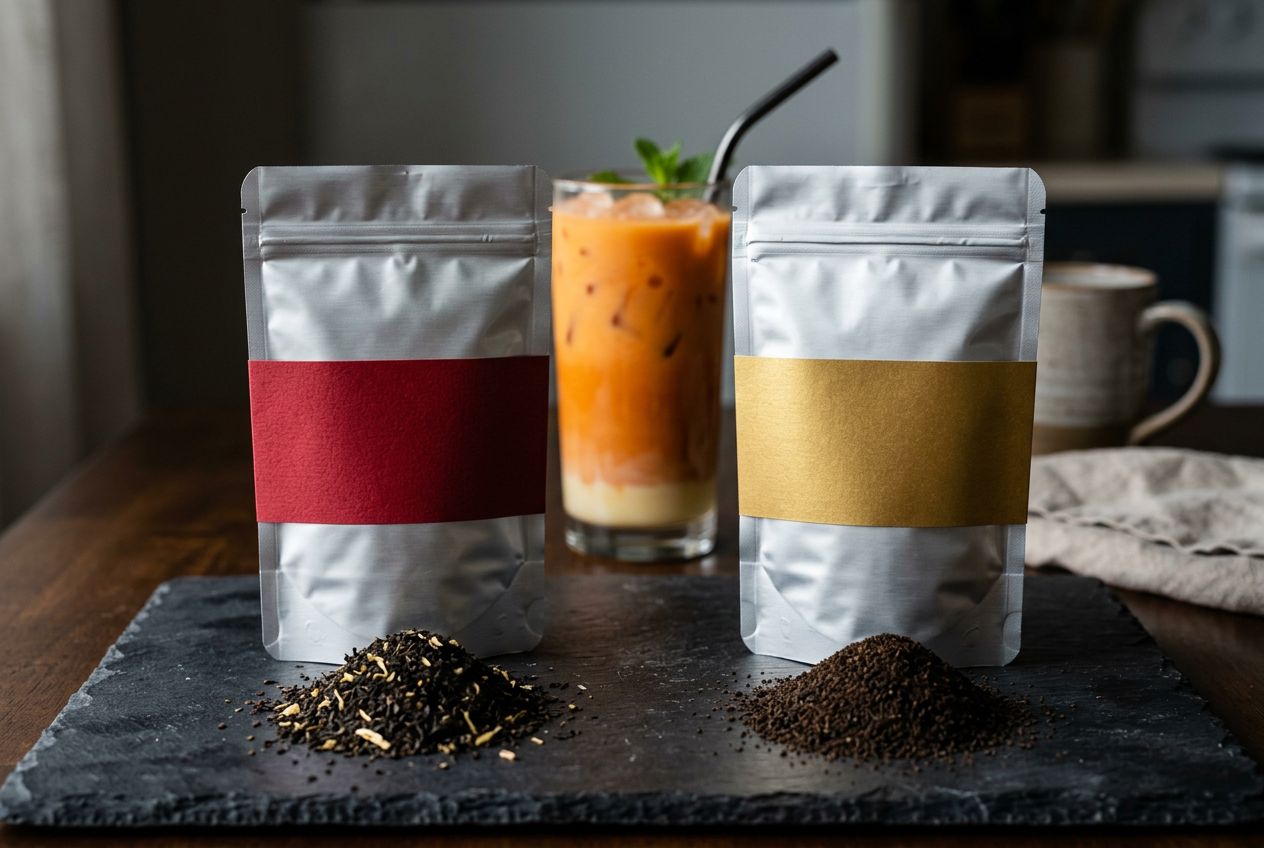
Extra Gold is sold as a selected-leaf blend put through a different process for a stronger, more aromatic cup, and side-by-side inspection backs that up: the gold is darker and more uniformly finely ground, while the red is coarser with lighter-coloured material mixed in. Brewed, the gold reads as slightly maltier with a touch more mineral character underneath.
Slightly. The artificial flavouring — the star-anise-ish note that makes Thai tea taste like Thai tea — appears to be the same in both, so the family resemblance is much louder than the difference. Independent side-by-side tasters land on "probably a bit better," not "obviously better."
Price
Extra Gold costs more, consistently, in the region of a quarter to a third more per bag depending on where you buy. Per glass that's still small money — which is exactly why this is a taste question rather than a budget one.
Where the difference shows up, and where it disappears
It shows up if you drink it strong, drink it black, or brew it long. A maltier, more mineral base has room to be noticed there.
It disappears the moment you make standard cha yen. Sweetened condensed milk plus evaporated milk over ice is a loud, sweet, fatty environment, and a small refinement in the tea base is the first casualty. If you're making the orange restaurant drink, the red bag gets you there and costs less.
The honest summary
Red for the classic drink and the classic price. Gold if you're curious, drink it strong, or want the marginally better base. Anyone telling you the gap is dramatic is selling you the more expensive bag.
If neither is what you wanted
Two common cases. If your tea keeps coming out weak or grey, the bag isn't the problem — it's usually ratio, steep time, or the milk, and buying up a tier doesn't fix any of them. The diagnosis is at the top of our why homemade Thai tea comes out wrong. And if you're here because you'd rather skip the colouring, neither bag qualifies — that comparison is Cha Tra Mue vs Yim.
Where to buy
We don't print prices — they move constantly and vary by shop. These go straight to a stockist so you can see today's.
- Cha Tra Mue red (Number One Brand) — the standard bag, and the one every stockist has. Check price →
- Cha Tra Mue Extra Gold — harder to find — neither grocer we checked stocks it, so start with a pan-Asian shop. Where to buy →
Frequently asked questions
Is Cha Tra Mue Extra Gold worth the extra money?
For most people making Thai iced tea with condensed milk, no — the red bag delivers the same drink for less. It's worth it if you brew strong or drink it without much milk, where a maltier base is noticeable.
Is the gold label dye-free?
No. Extra Gold lists artificial colour E133 and E102; the red lists FD&C Yellow No. 6 (E110). Different colourings, both artificial. Dye-free Thai tea is a separate tier that brews amber-brown.
Can I use gold and red interchangeably?
Yes, at the same ratio — roughly 10 g of mix per 350 ml of water, steeped about 5 minutes, strained, then condensed milk and ice. Our classic recipe works with either.
What about the green Cha Tra Mue bag?
That's their green tea mix — a different drink, not a stronger or weaker version of Thai iced tea.
Ingredient panels change and vary by import market. We've quoted what current retail listings state; check the bag in your hand if a specific colouring matters to you.