Some links on this page are affiliate links — if you buy through them we may earn a small commission at no extra cost to you. How we make money.
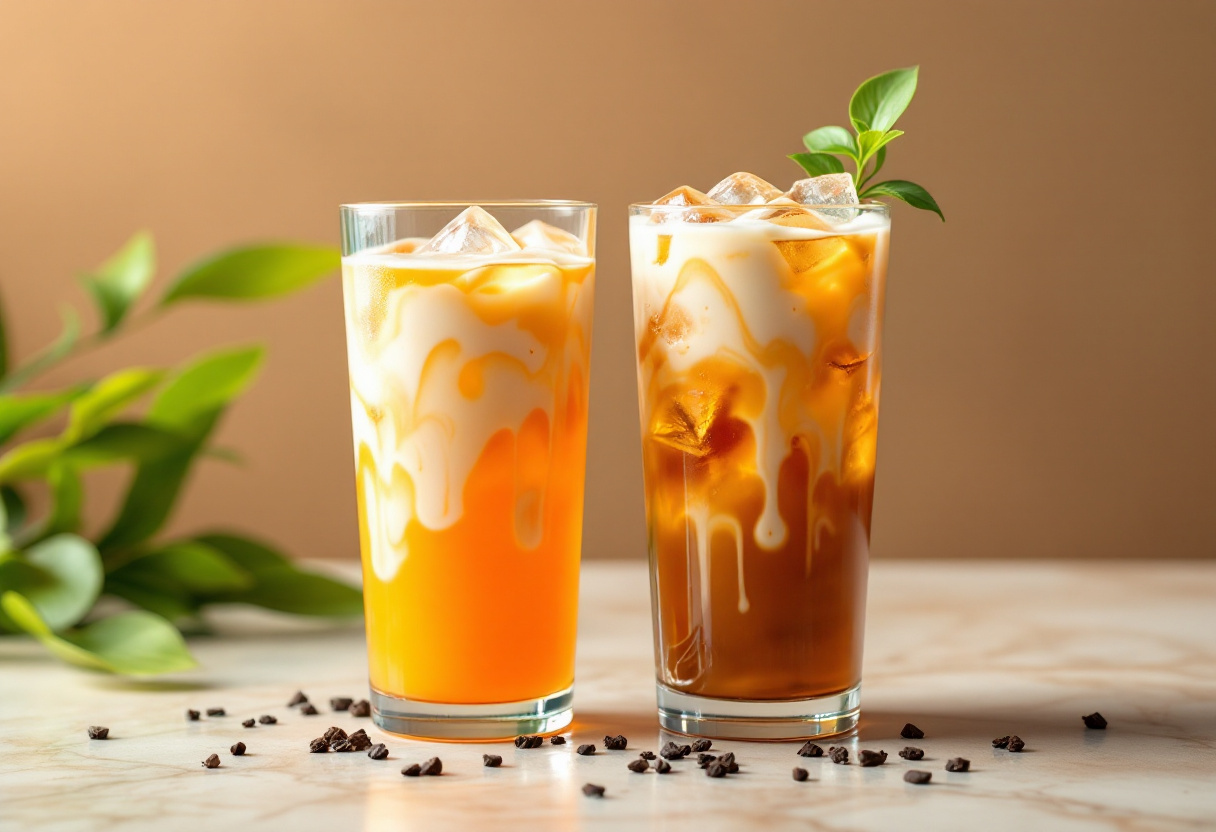
Yes — Thai tea without dye exists, and it tastes the same. What changes is the colour in the glass. Standard Thai tea mix gets its neon orange from added food colouring, usually FD&C Yellow No. 6 (Sunset Yellow FCF), sometimes with Red 40. Take the dye out and the same tea brews a natural amber-brown — or pink, or blue, depending on what the maker uses instead.
That one sentence is the thing most people are actually asking, and almost nobody says it plainly. Below: what the dye is, what each dye-free option brews, and how to pick.
We earn a small commission on some links, at no cost to you. It never affects what we recommend.
What the orange actually is
The tea itself is Assam or Ceylon black tea. Brewed strong, it's a deep reddish brown — nothing like the traffic-cone orange you see at a Thai restaurant. The colour is added.
The usual colouring in traditional Thai tea mix is FD&C Yellow No. 6 — the same compound Europe labels E110 and calls Sunset Yellow FCF — sometimes alongside Red 40 (Allura Red / E129). Some mixes also carry added vanilla or star anise flavouring.
Both dyes are approved for food use in the United States and the European Union. The regulatory difference is worth knowing, because it's usually what sends people searching: in the EU, foods containing Sunset Yellow FCF or Allura Red must carry the label "may have an adverse effect on activity and attention in children." The US requires no such warning. That is a labelling rule, not a finding of harm — but it explains why a lot of people would rather skip it, and it's a reasonable preference either way.
If you're only avoiding the colour, you're not giving up anything else. The dye contributes nothing to flavour, body, or aroma.
What colour does dye-free Thai tea actually brew?
This is the real decision, and it's the one every roundup skips. Dye-free brands take four different routes, and they end up in four different glasses.
1. Amber-brown — no colourant at all
The honest baseline. Just tea, sometimes with natural vanilla. With condensed and evaporated milk it finishes a warm caramel-brown, roughly the colour of a milky English breakfast tea. This is what Thai tea looks like without a dye industry. Brands: Yim (100% natural Assam, the widest-stocked option), RIMA (Nan-region Assam), Lam Tae (northern Thailand, subtle vanilla), LA MOON (single-origin Ceylon, unsweetened).
2. Orange — from carotenoids instead of dye
The closest thing to the restaurant look without synthetic colour. Carotenoids are the natural orange-yellow pigments found in plants like annatto and safflower. The result is a softer, warmer orange — not neon, but recognisably Thai tea. Raming Amber Sky is the one to look at here.
3. Pink — from beetroot
A deliberate change of look rather than an imitation of it. Beetroot gives a rose-pink cup that turns soft and creamy under milk. It photographs beautifully and it is unmistakably not trying to be the orange version. Raming Rosechana is the pink blend.
4. Blue — from butterfly pea flower
Butterfly pea (Clitoria ternatea) brews a deep blue that turns violet the moment you add anything acidic — a squeeze of lime will do it in front of you. With milk it lands somewhere between lavender and grey-purple. Raming Blue Moon blends it with Assam. This is the option to pick if you want a talking point, not a replica.
What if you don't want to brew at all?
Everything above is a loose mix: you brew it, you strain it, you add your own milk. If that's more effort than you want, there is one dye-free option that skips the whole process — MUZ, a Thai brand selling 3-in-1 instant sachets with the tea, milk and sugar already in. Add hot water, stir.
The interesting part is what they leave out. Almost every instant Thai tea is built on non-dairy creamer — glucose syrup and hydrogenated palm or coconut oil doing an impression of milk. It's cheap, it's shelf-stable, and it's most of why instant Thai tea tastes flat next to the brewed version. MUZ doesn't use it. The brand confirmed its current formula to us directly in August 2026: Assam tea, oat milk powder and skimmed milk powder for the creaminess, sweetened with coconut blossom sugar at a lower sweetness than the category norm, and no artificial colouring.
To be clear about one thing: it is not dairy-free. The skimmed milk powder is real dairy, and MUZ says so plainly rather than leaning on the oat milk to imply otherwise. What it is is creamer-free, which is the rarer claim and the one that changes how the cup tastes. Their US listing puts it at 65 calories a sachet. With no colourant in the packet it lands in the same amber-tan family as the loose mixes above, not the neon orange.
What you give up is control. The sweetness and the milk ratio are decided for you, and neither can be dialled back — which is exactly the thing our classic recipe spends its time getting right. Treat it as the convenience option, not the best cup. And if you're avoiding dairy entirely, this isn't your route despite the oat milk — brew a loose mix and use our dairy-free method instead, which is the only way to get a genuinely dairy-free cup that still tastes right.
Which one should you buy?
- You want the restaurant taste and don't care about the colour → any of the amber group. Yim is the easiest to find and the most reviewed. Check price →
- You want it to still look like Thai tea → the carotenoid route, Raming Amber Sky. Check price →
- You're making it for other people and want the reaction → pink (Rosechana) Check price → or blue (Blue Moon) Check price →.
- You already brew loose-leaf and want maximum control → LA MOON, unsweetened single-origin Ceylon Where to buy →, or RIMA Where to buy →.
- You don't want to brew or strain anything → MUZ instant sachets — no dye and no non-dairy creamer, which no other instant we found can say. Contains skimmed milk, so not an option if you're strictly dairy-free. Check price →
- You want the cheapest authentic cup and the dye isn't a dealbreaker → stay with ChaTraMue and read our best Thai tea mix guide.
Brand details reflect what each maker states on its own packaging and listings, checked August 2026. The MUZ formulation above was confirmed with the brand directly after we found its retail listing and its own site disagreeing; we corrected this page the same day. Formulations change — read the ingredient panel before you buy, especially if you're avoiding a specific additive. Spot something wrong? Tell us and we'll fix it.
Why yours came out wrong (and it's probably not the tea)
The single most common complaint about Thai tea at home isn't the colour — it's that it doesn't taste like the restaurant. Switching to a dye-free mix won't fix that, because the dye was never the problem. These four things are:
- You brewed it too weak. The biggest one by a distance. Restaurant cha yen is brewed far stronger than tea you'd drink plain, because ice and milk are about to cut it in half. Use roughly 2 tablespoons of loose mix per 8 oz of water and steep 3–5 minutes. If it tastes slightly too strong on its own, it's right.
- You sweetened it cold. Sugar and condensed milk dissolve in hot tea, not iced tea. Sweeten while it's still warm or you get a gritty, under-sweet glass.
- You used the wrong milk. Traditional Thai tea uses two: sweetened condensed milk stirred in for sweetness and body, then evaporated milk floated on top. Regular milk makes it thin, and skim makes it watery.
- You didn't strain it. Loose mix is fine-cut and leaves sediment. A fine mesh strainer works; a traditional Thai tea sock works better.
Full method with exact ratios: our classic Thai iced tea recipe. Dairy-free version: here.
What you'll pay
Dye-free Thai tea costs meaningfully more than the mainstream mixes — expect roughly two to three times as much per ounce. A standard ChaTraMue bag sits at the bottom of the market; the natural mixes generally run $15–30 depending on size.
Whether that's worth it depends entirely on how you drink it. If Thai tea is an occasional treat, the difference is a couple of dollars a month and the choice is easy. If you're making it daily, it's a real line item. Neither answer is wrong — but you should know you're paying for the absence of an ingredient, not for better tea.
Frequently Asked Questions
Is there a Thai tea without dye?
Yes. Yim, RIMA, Lam Tae and LA MOON make Thai tea with no added colouring at all — they brew amber-brown. Raming offers three naturally coloured blends instead: orange from carotenoids, pink from beetroot, and blue from butterfly pea flower.
What dye is in Thai tea?
Traditional Thai tea mix is coloured with FD&C Yellow No. 6, known in Europe as E110 or Sunset Yellow FCF, sometimes together with Red 40 (Allura Red, E129). Both are approved for food use in the US and the EU. In the EU, foods containing them must carry a label noting they "may have an adverse effect on activity and attention in children"; the US requires no equivalent warning.
Does dye-free Thai tea taste different?
No. The colouring contributes nothing to flavour, body or aroma. A dye-free mix made from the same grade of Assam tastes like Thai tea — it just doesn't look orange.
Why is my homemade Thai tea not orange?
Because the orange comes from added dye, not from the tea. If your mix is dye-free, amber-brown is the correct result and nothing has gone wrong. If you're using a standard dyed mix and it still looks pale, you brewed it too weak — use more mix and steep longer.
Is Thai tea without dye healthier?
It contains one fewer additive. Beyond that, the nutrition is essentially identical — the calories and sugar in Thai iced tea come from the condensed and evaporated milk, not the tea or the colouring. See our nutrition guide for the numbers.
Can I make Thai tea orange without artificial dye?
Yes, with carotenoid-based blends like Raming Amber Sky, which use natural plant pigments. The result is a softer, warmer orange rather than the neon shade of the dyed mixes.
Where can I buy dye-free Thai tea?
Most of these are easiest to find online — the natural brands have limited shelf presence in Asian grocers, which mostly stock the mainstream dyed mixes. See our where to buy Thai tea page for stockists.