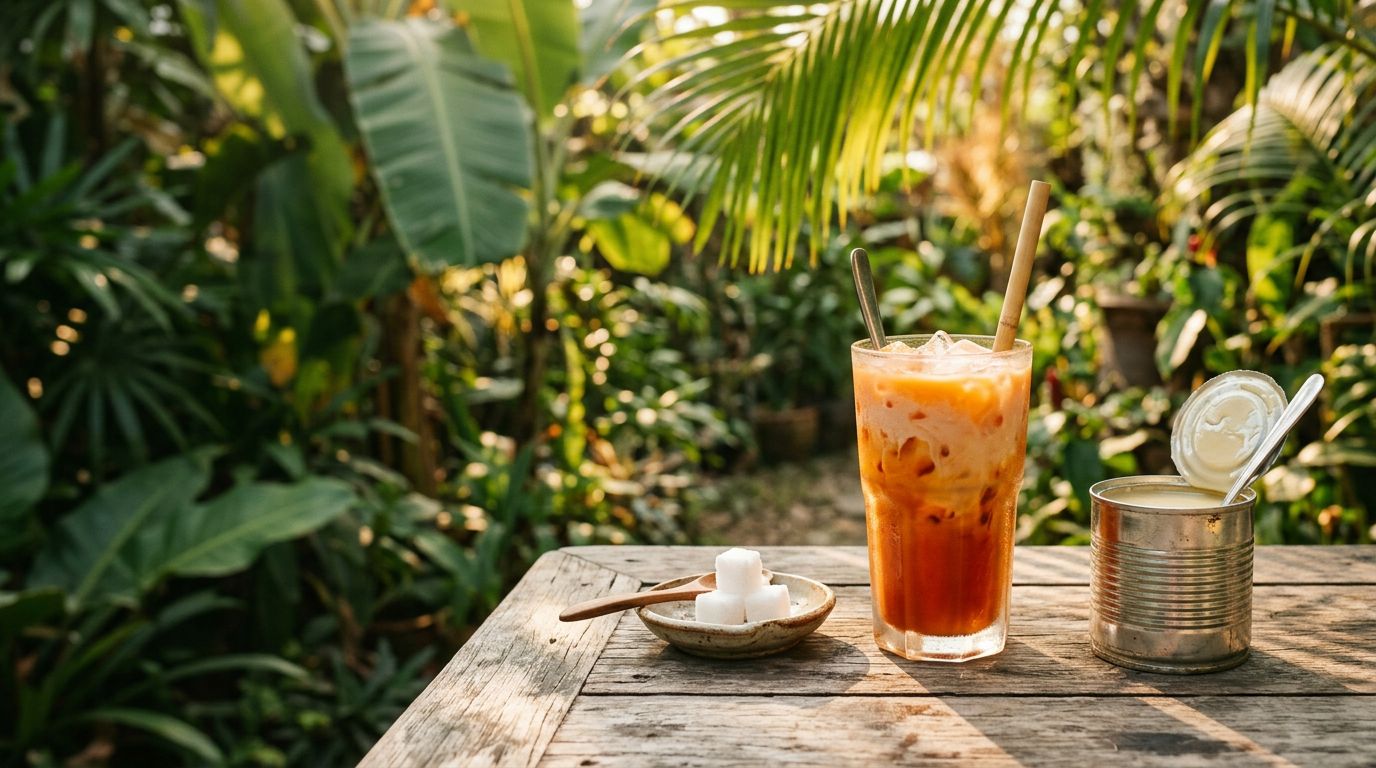
No — Thai iced tea is not a healthy drink. It is a dessert that happens to contain tea. A typical glass carries 150–250 calories and 20–35 grams of sugar, which is five to eight teaspoons, most of it from sweetened condensed milk. As an occasional treat that is completely fine. As a daily habit it is one of the easier ways to drink several hundred calories a day without noticing.
That is the whole answer. The rest of this page is the detail behind it: what is actually in the glass, what it compares to, what it does have going for it, and how to make it lighter without making it taste like disappointment.
What's actually in the glass
Per typical 12–16 oz serving, no boba:
- 150–250 calories
- 20–35 g sugar — roughly 5–8 teaspoons
- 4–8 g fat, from the condensed and evaporated milk
- 45–80 mg caffeine — see caffeine in Thai tea
The tea is not the problem. Brewed Thai tea on its own is close to zero calories. Everything above comes from what gets added to it — which is also the reason the drink is fixable rather than doomed. The full breakdown, including carbs and protein, is in the nutrition guide.
Is Thai iced tea bad for you?
Not bad in the sense of harmful — bad in the sense of sugary. There is nothing in a standard Thai iced tea that is dangerous to a healthy adult. What there is, is a lot of sugar in a form that goes down very easily, because cold sweet drinks do not fill you up the way food does. A glass a week is a non-event. A glass a day is roughly 1,000–1,750 extra calories a week, and that is the part worth being honest about.
Two things make it worse than the numbers suggest. Boba adds roughly 100–150 calories per quarter-cup of cooked pearls, so a large boba Thai tea can clear 400 calories. And the standard restaurant pour has been getting bigger — a 24 oz glass is not a 16 oz glass, and the sugar scales with it.
The orange colouring gets raised a lot, so: it is a cosmetic food dye, not a nutritional problem, and it is a labelling question rather than a health one. We cover what is actually in it, and which brands leave it out, in Thai tea without dye.
Is there anything good about it?
A little, and it is worth keeping in proportion. Black tea contains polyphenols — the same compounds that make plain tea worth drinking — and they do not vanish because milk and sugar were added. The caffeine is a genuine lift, at a level below coffee.
What that does not make it is a health drink. You would get the same polyphenols from a cup of plain black tea for zero sugar and zero calories. Anyone selling Thai iced tea on its antioxidants is selling you the tea and quietly not mentioning the condensed milk. Drink it because it tastes good — that is a perfectly good reason, and it is the honest one.
How it compares to other drinks
Per typical serving, roughly:
- Thai iced tea: 150–250 cal, 20–35 g sugar
- Cola, 12 oz: about 140 cal, 39 g sugar — more sugar, fewer calories. Thai tea's fat comes from the milk
- Sweetened boba milk tea: comparable or higher, especially with pearls
- Plain black tea, unsweetened: essentially zero of both
So it sits with the sweet drinks, not with the teas. If you were choosing it over a soda thinking "tea is the healthier option", the numbers do not support that — they are in the same bracket.
How to make it lighter
Ranked by how much they actually move the numbers, rather than how virtuous they sound:
- Use less condensed milk. It is the single biggest source of both the sugar and the calories, and halving it changes the drink less than you would expect because the tea is strong.
- Pour a smaller glass. Boring, and the most reliable thing on this list.
- Skip the boba when you are not specifically in the mood for it — it is the most calories per gram of enjoyment in the whole drink.
- Sweeten separately. Unsweetened evaporated milk or a plant milk, plus sugar you add yourself, means you control the amount instead of the can doing it for you.
Our dairy-free version is built this way — coconut or oat milk with the sweetener added separately — and the classic recipe tells you exactly how much condensed milk goes in, so you know what you are cutting. What will not work is switching brands. Every Thai tea mix is roughly the same nutritionally; the sugar arrives afterwards.
Weight loss, diabetes, and pregnancy
For weight loss: Thai iced tea is not a tool for it. It is not disqualifying either — a 200-calorie drink fits into plenty of days — but it is a drink you budget for, not one that helps. Made with plant milk and little sweetener it drops well under 100 calories, which is a different proposition.
If you are managing blood sugar, pregnant, or have any condition where sugar or caffeine matters, this page is not the right source. The numbers above are accurate and you are welcome to take them to the conversation, but 20–35 g of sugar and 45–80 mg of caffeine mean different things for different people, and your doctor or dietitian can answer for your situation in a way a web page cannot.
Common questions
Is Thai iced tea healthy?
No. It is a sweet, creamy drink with 150–250 calories and 20–35 g of sugar per glass — closer to a dessert than to tea. It is fine occasionally; it is not something to drink daily for your health.
Is Thai iced tea bad for you?
Not harmful, just sugary. Nothing in a standard glass is dangerous to a healthy adult. The concern is quantity — a daily glass adds roughly 1,000–1,750 calories a week.
Is Thai milk tea healthy?
Thai milk tea and Thai iced tea are the same drink under two names, so the answer is the same: a sweet treat rather than a health drink.
Is Thai tea good for weight loss?
No. A standard glass is 150–250 calories, mostly sugar. Made with plant milk and minimal sweetener it drops well under 100, which fits a calorie target — but the drink itself does nothing for weight loss.
Does Thai iced tea have any health benefits?
The black tea it is brewed from contains polyphenols, and the caffeine is a real lift. You would get the same from plain black tea without the sugar and calories, so it is not a reason to choose it.
For the full nutrition table — carbs, fat, protein, and calories by serving size — see the Thai iced tea nutrition guide.