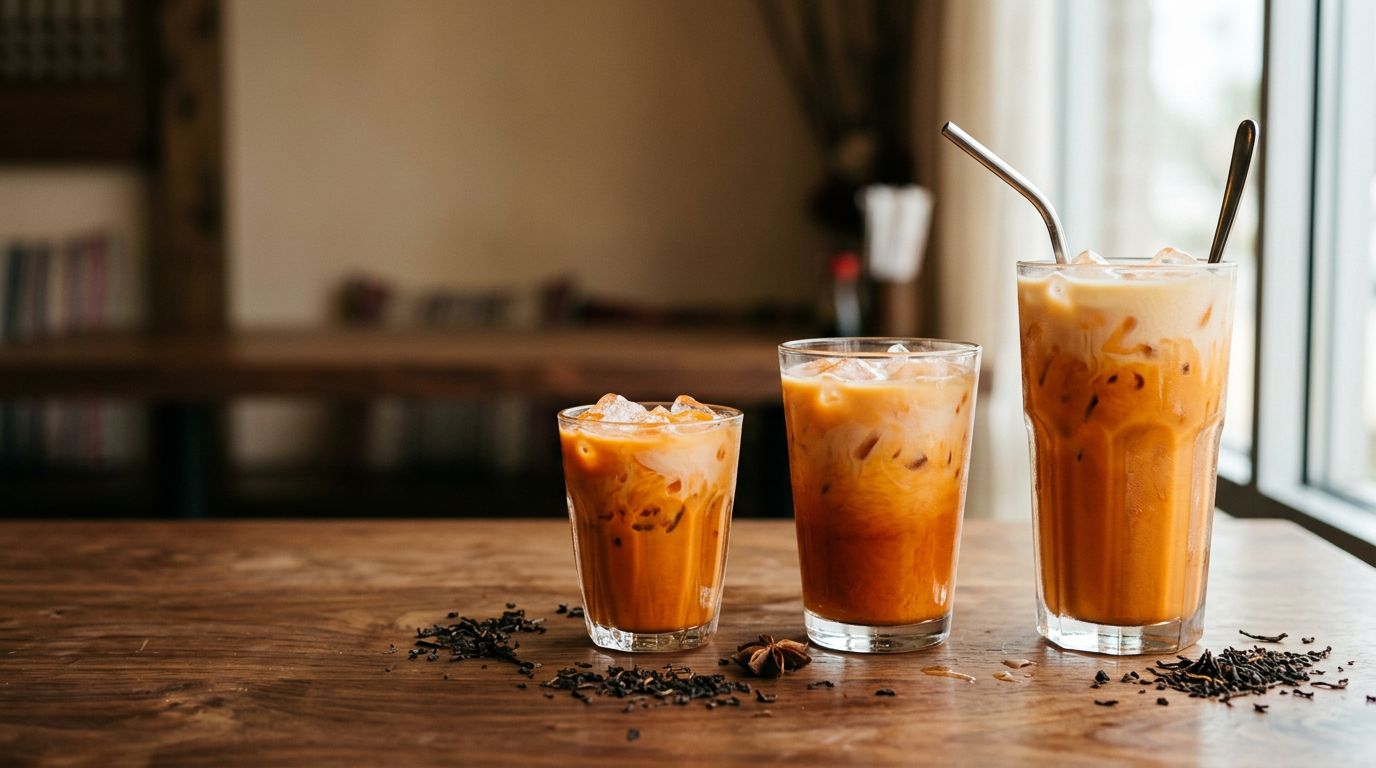
A 16 oz (470 ml) Thai iced tea has roughly 45–80 mg of caffeine, with about 62 mg being typical. That is a little over half a cup of drip coffee, and about the same as one shot of espresso. Thai tea is made from black tea, so yes, it always contains caffeine — there is no decaf version sold in any meaningful quantity.
The spread is wide because "a Thai iced tea" is not a fixed thing. Glass size, how strong the tea was brewed, and how much of the glass is milk and ice all move the number, and they move it a lot. Want the figure for your exact glass? Use the Thai tea caffeine calculator — the numbers on this page come from the same model.
How much caffeine by glass size
Classic cha yen — brewed at normal strength, with condensed milk and ice:
- 8 oz (240 ml): about 31 mg
- 12 oz (350 ml): about 46 mg
- 16 oz (470 ml): about 62 mg — the standard restaurant glass
- 20 oz (590 ml): about 77 mg
- 24 oz (710 ml): about 92 mg
Brew it light and each of those drops by roughly a third; brew it extra strong and each rises by about the same. Ordered black over ice — cha dam yen, no milk — the same glass carries around 35% more caffeine, because more of the glass is actually tea.
Does Thai tea have caffeine at all?
Yes. Thai tea is black tea — usually Assam or Ceylon — blended with star anise, tamarind and other spices, and often coloured. The spices and the colouring contribute nothing caffeine-wise. The caffeine comes entirely from the tea leaves, in the same way it would from any strong cup of black tea.
That holds for every version you are likely to meet. Thai milk tea is the same drink under a different name, so the answer is the same. Boba Thai tea is the same drink with tapioca pearls added — the pearls are starch and carry no caffeine, so a boba Thai tea has the same caffeine as the glass it was made from, just more calories. Dye-free Thai tea is also unchanged: taking the colouring out does not touch the tea.
The one real exception is Thai green tea — the bright green drink sold alongside the orange one. It is green tea rather than black, so it lands lower, in the region of half.
Thai tea vs coffee, and everything else
Per typical serving, against the drinks people ask about most:
- Drip coffee, 8 oz: about 95 mg — coffee wins comfortably. A 16 oz Thai iced tea is roughly two-thirds of one small coffee.
- Espresso, single shot: about 63 mg — near enough identical to a 16 oz Thai iced tea.
- Green tea, 8 oz: about 28 mg — Thai tea has roughly double.
- Cola, 12 oz: about 34 mg — Thai tea has noticeably more.
So the short version of does Thai tea have more caffeine than coffee is no, not per cup — but a 24 oz Thai iced tea and an 8 oz drip coffee land in the same place, and the Thai tea is the one that tastes like dessert and is easier to drink quickly. If caffeine is what you are tracking, the glass size matters more than the drink.
Thai iced coffee is a different drink
Worth separating, because the names are one word apart. Thai iced coffee — oliang — is coffee, brewed strong and served sweet over ice, and it carries substantially more caffeine than Thai iced tea does. If you are holding something dark brown and coffee-flavoured rather than orange and tea-flavoured, none of the numbers on this page apply to it. Everything here is about the orange one.
How to get less of it
There is no decaf Thai tea mix sold at any real scale, so decaffeinating is not one of the options. What actually works, in order of how much it moves the number:
- Pour a smaller glass. Caffeine scales directly with size and nothing else does as much work.
- Brew lighter — less mix, or a shorter steep. Costs you some of the flavour, which is the honest trade.
- Go heavier on milk and ice. Less of the glass is tea, so less of the glass is caffeine.
- Order it with milk rather than black. Cha dam yen is the stronger one, not the lighter one, which surprises people.
Decaf black tea brewed with Thai tea spices gets you most of the way there at home, but it will not taste like the restaurant version — the mix is doing more than the tea alone. Our classic recipe shows exactly how much tea goes into a glass if you want to adjust it deliberately.
If you're pregnant or caffeine-sensitive
The commonly cited guidance during pregnancy is under 200 mg of caffeine a day. A standard 16 oz Thai iced tea at about 62 mg sits well inside that on its own — roughly a third of the day's allowance — but it is a sweet drink and it is rarely the only caffeine in a day, so it is the running total that matters rather than the one glass. This is general information, not medical advice: if it matters for your pregnancy or a medical condition, ask your doctor or midwife, who can answer for your situation in a way a web page cannot.
Where these numbers come from
Brewed black tea yields roughly 5–9 mg of caffeine per ounce depending on how strongly it is made. In a classic cha yen, only about 55% of the glass is actually tea — the rest is ice, condensed milk and evaporated milk — so a 16 oz glass contains around 8.8 oz of tea, which is where 45–80 mg comes from. Served black over ice the tea fraction rises to about 75%, which is the 35% increase noted above.
These are estimates, not lab measurements. Caffeine in tea varies with leaf, harvest, grind and steep time, and no two shops brew identically. Treat them as a reliable range rather than a precise figure, and use the calculator to fit the range to your own glass.
Common questions
How much caffeine is in a Thai iced tea from a restaurant?
Most restaurant servings are 16 oz, which works out to about 62 mg — a little over half a cup of drip coffee. A 24 oz size pushes it to roughly 92 mg.
Does Thai tea have more caffeine than coffee?
No, not cup for cup. An 8 oz drip coffee is about 95 mg against a 16 oz Thai iced tea's 62 mg. A very large Thai iced tea can match a small coffee, but the drink itself is weaker.
Does Thai milk tea have caffeine?
Yes — Thai milk tea and Thai iced tea are the same drink, so the same 45–80 mg range applies to a 16 oz glass.
Is there a decaf Thai tea?
Not one sold at any real scale. To cut caffeine, use a smaller glass, brew lighter, or add more milk and ice. Decaf black tea brewed with Thai spices works at home but does not taste like the restaurant version.
Does boba Thai tea have more caffeine?
No. Tapioca pearls are starch and contain no caffeine, so a boba Thai tea has the same caffeine as the tea it was made with — just more calories.
For calories, sugar and the full nutrition picture, see the Thai iced tea nutrition guide. For what is actually in the mix, see what is Thai iced tea.