Some links on this page are affiliate links — if you buy through them we may earn a small commission at no extra cost to you. How we make money.
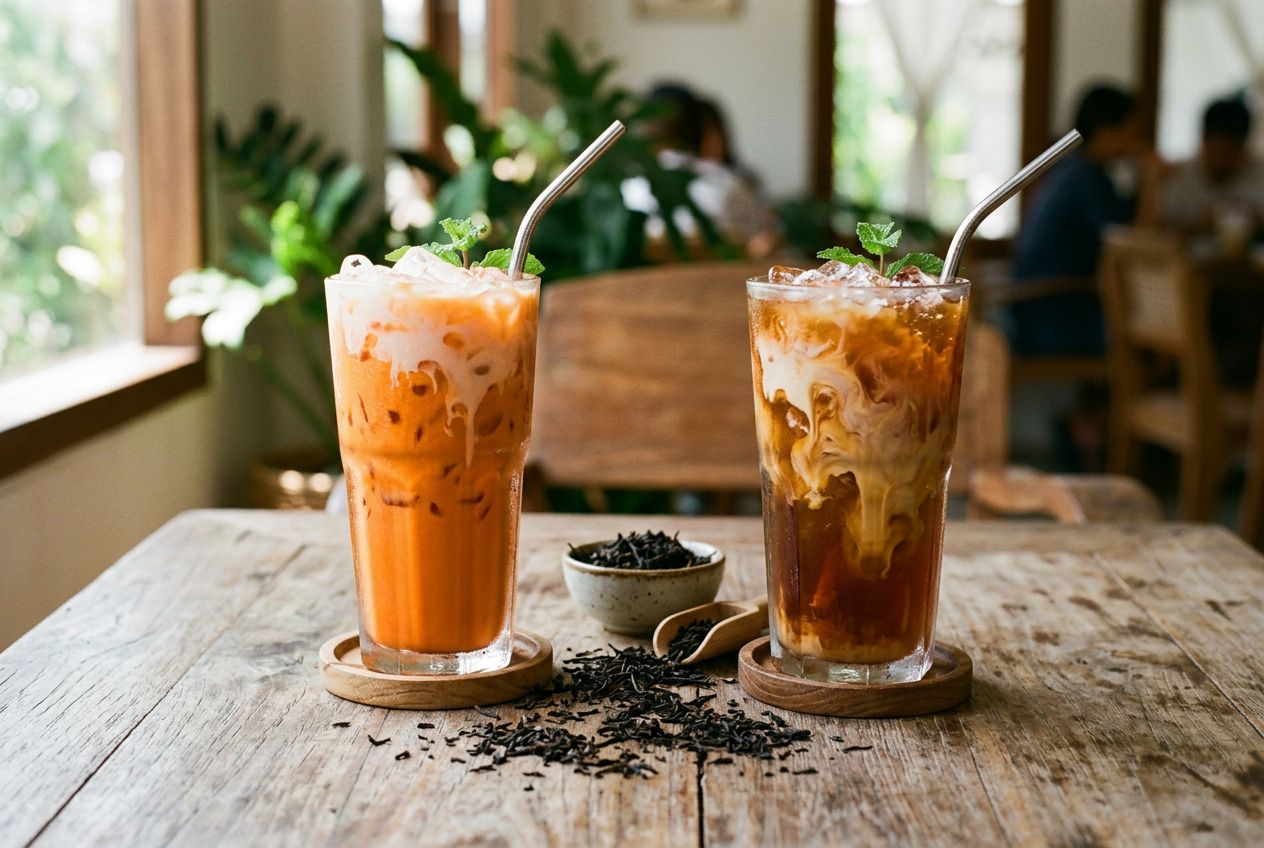
This comparison comes down to one question: do you mind that the orange is added? If you don't, buy Cha Tra Mue — it's the restaurant benchmark and the cheapest good option by a wide margin. If you do, buy Yim, accept that your glass will be amber-brown instead of orange, and expect to pay roughly two to three times as much per ounce.
What you are not trading is flavour. That's the part most people get wrong on the way in.
What each one is
Cha Tra Mue — "Number One Brand" — has made the same blend since 1945. Strong, malty black tea with warm spice and the signature orange, built to hold up under sweetened condensed and evaporated milk. It's the tea behind most restaurant cha yen, it's stocked in essentially every Asian grocery, and it's cheap. The colour comes from FD&C Yellow No. 6.
Yim is 100% natural Assam loose leaf, lightly flavoured with real vanilla, with no artificial colouring at all. It's the widest-stocked of the dye-free tier and the one we recommend first in that group. Brewed with milk it lands a warm caramel-brown — roughly the colour of a milky English breakfast tea, and nothing like the traffic-cone orange.
The dye, stated plainly
The tea itself is never orange. Brewed strong, Assam or Ceylon black tea is a deep reddish brown. The orange is added, and it contributes nothing to flavour, body or aroma.
The usual colouring is FD&C Yellow No. 6 — Europe labels it E110, Sunset Yellow FCF — sometimes with Red 40. Both are approved for food use in the US and the EU. The difference that sends most people searching is a labelling one: in the EU, foods containing them must carry "may have an adverse effect on activity and attention in children." The US requires no such warning.
That's a labelling rule, not a finding of harm — and preferring to skip it is a perfectly reasonable position either way. Full detail: Thai tea without dye.
What you actually give up
The colour — and it matters more than people admit
Thai iced tea is a drink people recognise by sight. A layered amber-brown glass is genuinely lovely and it will not read as Thai tea to a guest who's expecting orange. If you're serving it to other people, that reaction is real and worth planning for. If you're drinking it yourself, you stop noticing in about two glasses.
The price
The dye-free tier holds a consistent premium of roughly two to three times per ounce across brands — it isn't a Yim quirk, it's what the whole natural tier costs. Per glass it's still a small number, which is why this is a values question and not a budget one for most people.
Availability
Cha Tra Mue is in every Asian grocery. Yim is mostly an online purchase. If you like buying tea in person, that's a real inconvenience.
Buy Cha Tra Mue if…
- You want the exact restaurant look and taste, especially for other people.
- You're price-sensitive, or you drink it daily.
- You want to buy it locally today rather than order it.
Buy Yim if…
- You'd rather not drink added colouring, for any reason, including no particular reason.
- You're making it for children and the EU label bothers you.
- You like the idea of tea that looks like tea.
- You want single-origin loose leaf rather than a blended mix.
If you want both — dye-free and orange
That exists, and it's the most useful thing on this page for a lot of people. Raming Amber Sky uses carotenoids — the natural orange-yellow pigments in plants like annatto and safflower — for a softer, warmer orange with no synthetic dye. Raming also makes a beetroot pink and a butterfly-pea blue if you'd rather change the look than imitate it. All three are in our dye-free guide.
Where to buy
We don't print prices — they move constantly and vary by shop. These go straight to a stockist so you can see today's.
- Cha Tra Mue (Number One Brand) — if the orange is the point and the dye is not a dealbreaker. Check price →
- Yim — the dye-free pick, sold direct by the brand — no grocer we checked carries it. Check price →
Frequently asked questions
Does dye-free Thai tea taste different?
Not because of the dye — the colouring adds no flavour. Yim tastes different from Cha Tra Mue the way any two blends differ: it's a clean, malty single-origin Assam with vanilla, rather than a spiced blend.
Will Yim turn orange if I brew it stronger?
No. Brewing stronger makes it darker brown, not orange. The orange only comes from added colour.
Is Thai tea dye actually bad for you?
Both dyes are approved in the US and EU. The EU requires an attention-related warning label; the US does not. That's the honest state of it, and we don't make health claims beyond it.
Is Yim the only dye-free option?
No — RIMA, Lam Tae and LA MOON also add no colour, and Raming offers naturally coloured blends. Yim is simply the easiest to find.
Comparing something else?
The full ranking is in best Thai tea mixes; other head-to-heads are on the comparisons page.